Painted Bunting
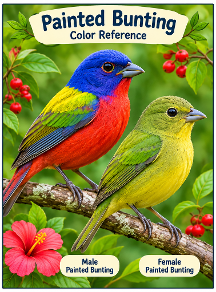
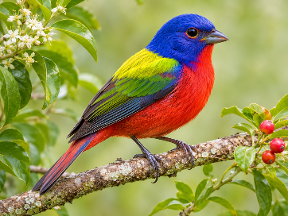
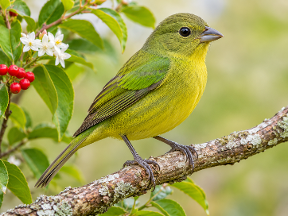
Often described as a living rainbow, the Painted Bunting is one of North America's most brilliantly colored songbirds. The adult male has a brilliant blue head, a bright red breast, a yellow-green back, and darker green wings. The female, in contrast, has soft green and yellow plumage that helps her blend into the surrounding vegetation.
Despite its spectacular appearance, the Painted Bunting is a rather shy bird that often remains hidden among dense shrubs and leafy branches.
Habitat -
Painted Buntings are found in parts of the southern United States, Mexico, Central America, and the Caribbean. They prefer woodland edges, coastal thickets, brushy areas, and gardens with plenty of protective vegetation.
Diet -
Painted Buntings feed primarily on seeds from grasses and other plants. During the breeding season, they also eat insects and spiders, which provide additional protein for themselves and their growing young.
They may visit backyard bird feeders containing white millet, especially when the feeders are located near shrubs that provide a safe place to hide.
Nesting -
The female builds a small, cup-shaped nest using grasses, leaves, fine roots, and other plant materials. The nest is usually concealed among dense shrubs or low tree branches.
She typically lays three or four eggs and incubates them for approximately 11 to 12 days. The young birds grow quickly and generally leave the nest within two weeks of hatching.
Lifespan -
Painted Buntings can live for several years in the wild. Some individuals have been recorded living for more than ten years.
Special Behavior -
Although the male's bright colors make him appear easy to spot, Painted Buntings can be surprisingly difficult to find. They frequently feed close to the ground and retreat into thick vegetation when disturbed.
During the breeding season, males sing to attract females and defend their territories. Their songs are a delightful series of sweet, musical notes.
Interesting Facts -
- The French name for the Painted Bunting is nonpareil, meaning "without equal."
Young males resemble females during their first year and generally develop their brilliant adult colors in their second year.
Painted Buntings are only about five inches long.
Their beautiful colors have unfortunately made them targets of illegal trapping for the cage-bird trade.
Attracting Painted Buntings to Your Garden -
If you live within their range, you may be able to encourage Painted Buntings to visit your garden by planting native grasses, providing dense shrubs, offering white millet, and maintaining a source of fresh water.
A garden that provides natural food, shelter, and protection from predators can become a welcoming haven for these remarkable little birds.